Unified Field Theory
The Unified Field Theory was started by Einstein, but he was
unable to complete it before he died. The theory attempts to unify all the forces of
nature. In honor of Einstein’s last
request, “but my theories, they’re not finished”, Dr. Klein spent more than two
decades developing a conceptual, graphical, and mathematical solution for the
Unified Field Theory.
The original 4 forces of nature that were included in the Unified
Field Theory were: the strong nuclear
force, the weak nuclear force,
electromagnetic force, and gravity.
According to the Unified Field Theory, the forces of nature
are not separate, but are all unified, or part of one more complex force (a
unified field).
According to Dr. Klein’s Unifield Field Theory:
Essentially, the unified field may be thought of as
consisting of pairs of attractive and repulsive forces on different size
scales. There is a balance in
nature; thus, each attractive force is balanced or opposed by a repulsive
force.
For each size scale, there exists a pair of forces—an
attractive force and a repulsive force that dominate at that size scale. The dominant attractive force is balanced or
opposed by the dominant repulsive force.
Thus, on the nuclear scale, there is the strong nuclear force (an
attractive force that holds the protons and neutrons together in an atomic
nucleus) and the weak nuclear force (which is responsible for nuclear decay).
On a larger scale, there is the electromagnetic force, which
has both attractive and repulsive components.
Thus, opposite charges attract each other, while like charges repel each
other. For magnetic fields, opposite
poles attract each other, while like poles repel each other.
On a still larger scale (from molecules to stars), gravity
is the dominant attractive force, and entropy is a repulsive force that opposes
gravity. See the Gravity-Entropy theory
for further explanation on gravity and entropy.
On a still larger scale, Dr. Klein postulated another Force,
the Galactic Force. The Galactic Force
has an attractive component, which holds the stars together in a galaxy
(gravity and the other forces of nature are too weak at the vast distances
between stars). The Galactic Force also
has a repulsive component for balance, and is why the stars throughout the
universe are grouped into galaxies, but are not on top of each other. The
Galactic Force is also responsible for the motion of stars within a galaxy.
On an even larger scale, Dr. Klein postulated the Galactic
Cluster Force. Hence, the Galactic
Cluster Force causes galaxies throughout the universe to be grouped together in
clusters.
As can be seen graphically below, all of these forces or
fields are really part of one unified field. In reality, since the real universe is infinite, the field extends
on even smaller scales, and also on even larger scales.
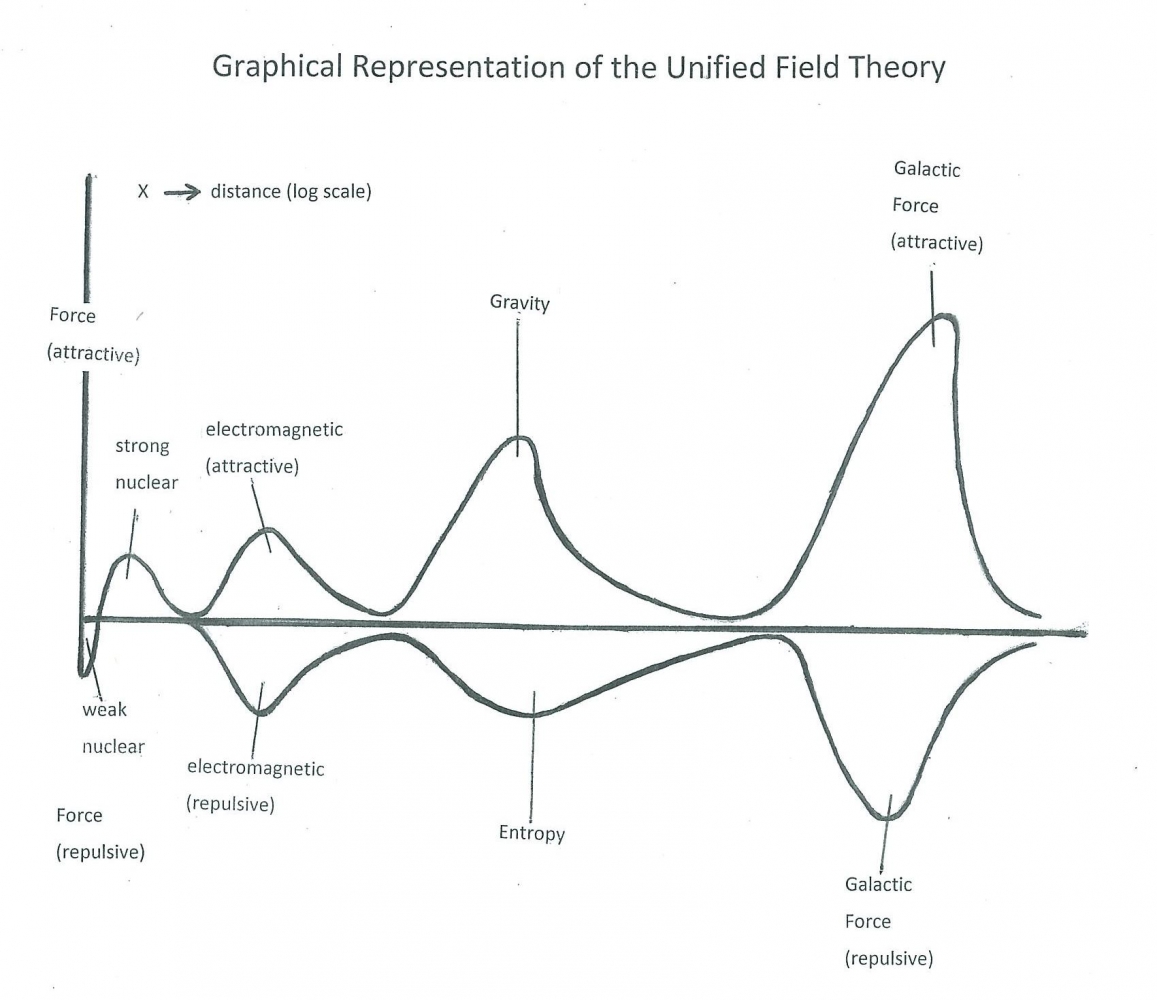
Figure 4:
Graphical Representation of the Unified Field Theory. There is a balance in nature; for each
attractive force, there is a corresponding repulsive force. The forces of nature occur in
attractive-repulsive force pairs on different size scales. Each force creates a field. As can be seen, the fields are all part of a
larger, more complex unified field.
This unified field can also be expressed mathematically. The mathematical solution described by Dr.
Klein is a system of parametric equations based on different size scales. Thus, on a given size scale, for x greater
than a, but less than b, a few equations dominate. However, on a different size scale, for
example, for X greater than b, but less than c, another set of equations
dominate.
Further, it should be noted that the attractive forces are
in a dynamic balance with the repulsive forces.
It is not a static balance. The
matter in the universe is constantly moving, constantly changing.














